Occasions & Formats
Birthday Dinner for Eight: The Table Is the Program
At eight people, a birthday does not need activities piled on top of dinner. Use the table, seating, food, one personal focal moment and an after-dinner shift to carry the night.
At eight people, the birthday dinner does not need an entertainment department.
The table is already doing enormous social work. Everyone can hear one another. The birthday person can actually speak to every guest. Food can arrive without a catering brigade. The room has enough bodies to feel alive and few enough that every awkward choice remains visible.
An eight-person birthday can feel unusually generous. It can also be exhausting, and the reason is almost always that the host looked at eight guests, decided it seemed too easy, and started adding things.
Choose the social promise before the menu
Is this a long dinner? A loud dinner? A beautifully dressed table with one serious toast? A casual meal that turns into drinks somewhere else? The answer changes what the room needs.
If the promise is conversation, protect sightlines and serving ease. If the promise is food, choose a menu that can land without the host plating eight individual masterpieces. If the promise is celebration, make the birthday person visible through one or two specific choices rather than plastering their age across the room.
A personal event should belong to someone, not merely to a demographic category.
Seat for conversation, not mathematical fairness
Eight is a useful number because everyone can participate in one conversation, but not if the table is too long or the seating accidentally separates the people who know nobody.
Seating is not political districting, though it does have consequences. Place the birthday person where they can see and reach everyone. Put strong conversational bridges beside guests who are newer to the group. And keep the two people with a private shorthand apart, because seated together at one end they will have founded an independent republic by the second course and will not be issuing visas.
If there is family tension, do not use proximity as a reconciliation strategy. Dinner is not mediation with candles.
For the larger principles, the seating-chart antidote still applies at small scale; the chart may simply live in the host’s head.
The table needs space for actual dinner
Eight place settings, water, wine, serving pieces, bread, condiments and whatever arrives from the kitchen will occupy more square footage than the empty table suggested.
Set one complete place. Put the serving dishes you plan to use on the table. Then decorate what remains.
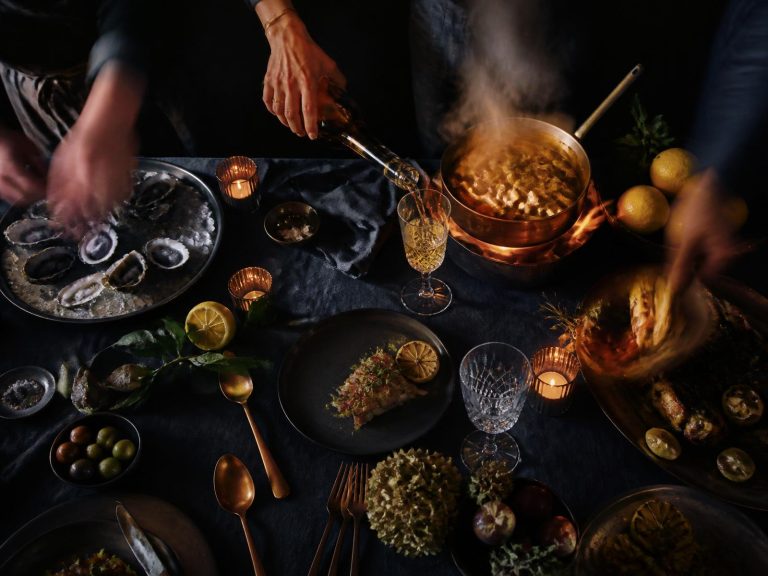
Keep the flowers low and tuck candles between the serving zones. Add a runner or cloth only if it helps the room, and put the birthday detail near the guest of honor instead of scattering eight identical decorative objects into everyone else’s elbow room.
Centerpieces for people who intend to see one another sounds like a title. At eight people it reads more like a tape measure.
Eight settings plus the serving dishes is a measurable quantity of table, and it is worth measuring before deciding what else gets to sit on it.
Measure the table for eight (opens in a new tab)
Do not make eight separate plates if one beautiful platter will work
The host should be seated while the meal is still hot enough to qualify as dinner.
Family-style service is excellent at this scale when the menu supports it. One composed first course can be ready. The main can arrive on platters. Dessert can be pre-portioned or served from one glorious cake without any individual garnish choreography.
If a dish requires last-minute precision, give it one job and make everything around it forgiving.
The birthday person does not feel more celebrated because the host spent the first course with tweezers. Occasion OS plans the food for the same evening, and it will tell you which dish is going to cost you the table.
Give the night one focal moment
Eight people can sustain a meaningful pause without it turning into a program.
A toast. A short round of stories. A letter from someone who could not attend. Cake. One gift from the group. A ridiculous photograph recreated badly. Pick one.
A toast, a slideshow, a game, gift opening, a speech from every guest and a ceremonial dessert cutting are all defensible on their own. Stacked into one evening they become a three-act biography, and the subject of the biography is the only person in the room who cannot leave.
The focal moment should sharpen the evening, not seize it.
Build the second act before guests arrive
One-table dinners can get stuck at the table because nothing else in the room gives people permission to move.
Create somewhere to go after dinner. A sofa with drinks already nearby. A porch with blankets. A record player. A card table. Dessert on the coffee table. Even standing around the kitchen can work if the kitchen is reset enough not to look like the aftermath of a small maritime incident.
Design the party in chapters. At eight people, the chapter change can be as small as changing rooms.
Drinks should not require the host every time
At two people, the host can refill a glass without becoming the bar. At eight, repeated drink questions start pulling one person out of the table.
Put water where guests can see it. Leave the open wine within reach. If there is one house drink, batch what can be batched and make the refill logic obvious. If someone is not drinking, give that option equal dignity rather than one lonely can of sparkling water hiding behind the milk.
Right around eight people, hospitality needs a little structure guests can see and use without asking. More on that kind of thinking is collected here.
Can the far end of the table hear the joke?
- Can everyone see and hear one another?
- Can the host serve dinner and sit down without a plating marathon?
- Does the birthday person appear in the design through something more specific than age?
- Is there one focal moment rather than a program?
- Is there a second act after the table?
If yes, eight people is enough for a real party and small enough for the event to remain personal.
At eight you can still hear the person at the far end laugh at something you said. That is what a short guest list buys you, and it is gone by twenty.
Field notes and corrections
When a number here turns out to be wrong, you hear about it.
Three things arrive and nothing else. The new field note — bar rates, cover widths, service clearances, the arithmetic worked through on one real evening. And a correction whenever a rule in the published rulebook changes, or a number the tools rely on turns out to have been wrong. There is no weekly slot, because there is nothing weekly to put in it.
One email per field note, plus corrections when a published figure moves. Unsubscribe from any of them.
Continue through the system
Pretty is still not a plan.
A party gets planned in roughly this order. Pick the chapter where your next problem lives.
What you have to decide next
One decision constrains the next. This is the order they actually happen in.
More in this chapter
See the complete five-chapter Event Design Intelligence map →