Design & Florals
One Thing Altered
The styling world for Nothing in This Room Is Finished — a wardrobe built on fit and inlay rather than on unbleached cotton.
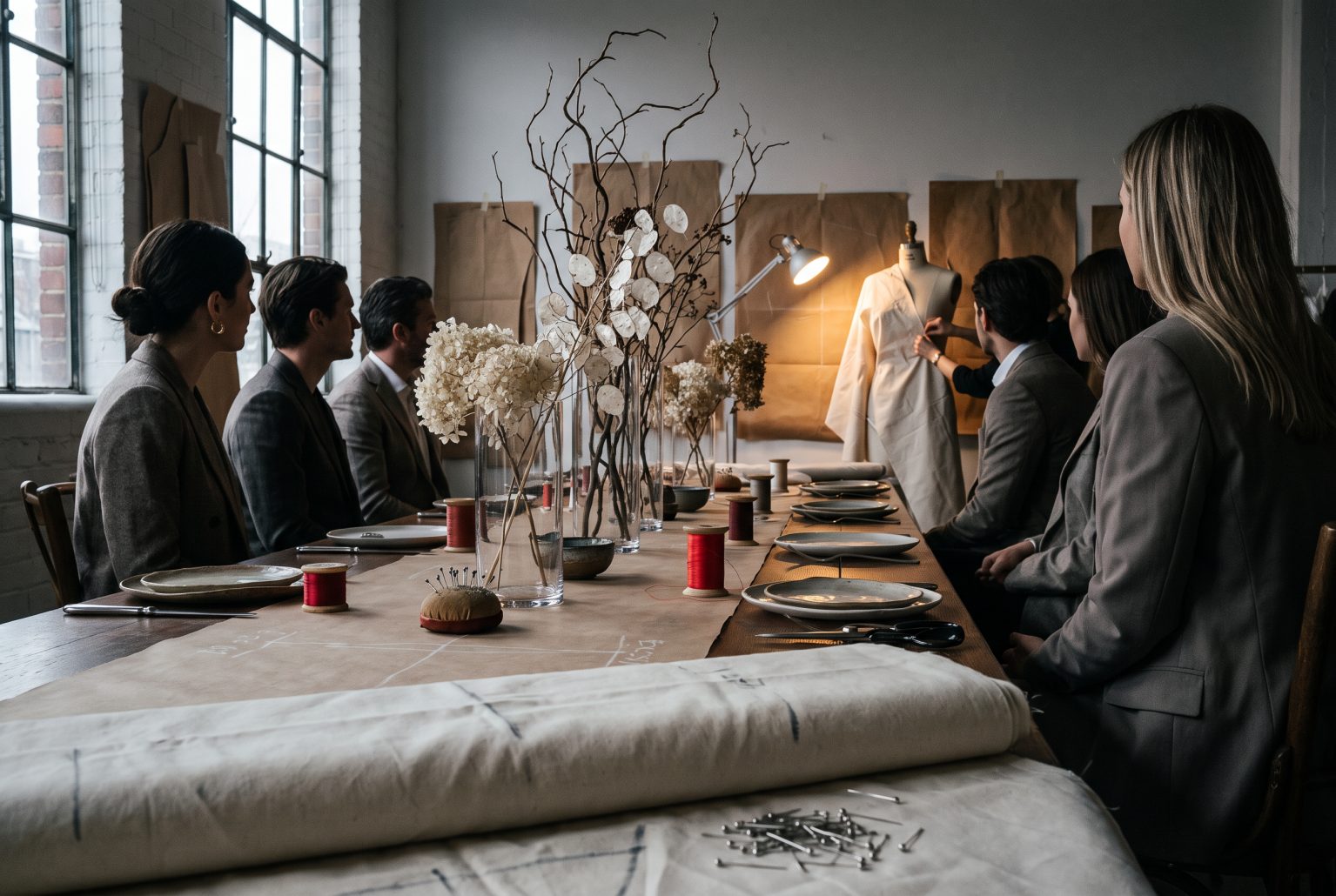
Editor’s note: written for an earlier version of Nothing in This Room Is Finished. The World has since been rebuilt: nobody marks guests’ clothes at the door, there is no flower arrangement, and the night is no longer framed around sixty guests. The principle below, one thing altered and nothing new, is still the one to dress by.
The evening is dressed as a couture fitting, which means the clothes cannot be a mood. They are the subject. A guest who arrives in something beautiful and badly fitted is standing inside a critique of themselves. That sounds cruel. It is the opposite, and the rest of this page is the reason why.
Start With the Fitting Room, Not the Runway
A toile is the trial garment. It is cut in calico, made up in long basting stitches, put on a body or a stand, and then read by somebody senior — a première d’atelier, in the workrooms that still use the title. Drag lines running from the bust point to the armhole mean the front is short. A collar standing away at the nape means the back neck needs scooping. Corrections go on in pencil and chalk, directly onto the cloth, in the place they apply. Seams are slashed, sleeves come off, and the whole thing is finally unpicked and traced back to paper.
Two facts from that process do the work here. The first is that the marks are language. Thread tracing — loose running stitch in soft cotton along a seam line — is how you carry a pattern line onto cloth you cannot draw on. Tailor’s tacks are looped stitches through two layers, cut apart so both pieces carry the same mark. A balance line is ruled level to the floor, and if it is not level the whole reading is worthless. Every one of those has a job, and it is visible.
The second fact is the one this Look Book is actually built on. In bespoke tailoring, seams are left with inlay: extra cloth folded into the back seam, the side seams, the sleeve head, so that in three years the garment can be let out. A garment cut with inlay is a garment that expects your body to change and has already forgiven it. I am not imposing a metaphor on the trade here. Inlay is standard practice, it is why bespoke outlives fast clothing, and it is the single most generous idea in the whole of clothes-making.
So: what I take is the evidence of construction and the expectation of alteration. What I refuse is the obvious version, which is dressing sixty people in unbleached cotton. Calico on a body reads as a hospital gown, an art-school degree show or a person in a bag, and worse, it makes the guest the same color as the tablecloth. Martin Margiela already did the honest version of the toile-as-garment — the white lining shown as the outside, the Stockman dress-form bodice, the numbered label — and did it in 1997 with an argument behind it. Doing it again at a dinner in 2026 reads as costume. I am taking the workroom’s logic and leaving its uniform alone.
Let the Alteration Stay Visible
The silhouette is the fitting stance. Stand as you stand when somebody is pinning you: weight even, arms down, shoulders not lifted. The garment is cut for that body in that position and then judged by whether it still works when the body stops behaving.
Close through the shoulder and the upper back. That is the whole proposition. The shoulder seam sits on the shoulder — on the bone, not an inch down the arm and not up on the trapezius — and the armhole is cut high and small. A high armhole is counter-intuitive and it is correct: it lets the arm move without dragging the whole body of the garment with it, which is why a well-cut jacket lets you reach across a table and a cheap one pulls the lapels open. If you take one thing from this page to a person with a machine, take that.
Then ease everywhere the body has to work: through the rib and waist, enough to lean forward on your forearms, because people lean on this table early; through the hip, enough that the cloth does not read the chair; sleeves narrow but not tight at the bicep, because one end of the room is warm and people push sleeves up.
Hems are decided at tacking length, which is the length a hem sits at before it is turned: a little longer than final, hanging straight, no roll. On trousers that means the hem breaks once on the shoe and stops. On a skirt it means mid-calf or just below the knee — the two lengths that read as chosen rather than defaulted. Full length is available and it is the one place volume is allowed to be extravagant, but it has to clear the floor by half an inch, because the floor of this room has pins on it at midnight.
Volume goes in one place only, above the waist: a gathered sleeve head, a box-pleated back, a collar cut deliberately large. Sixty people in volume top and bottom turns a calico room into weather.
The cloth
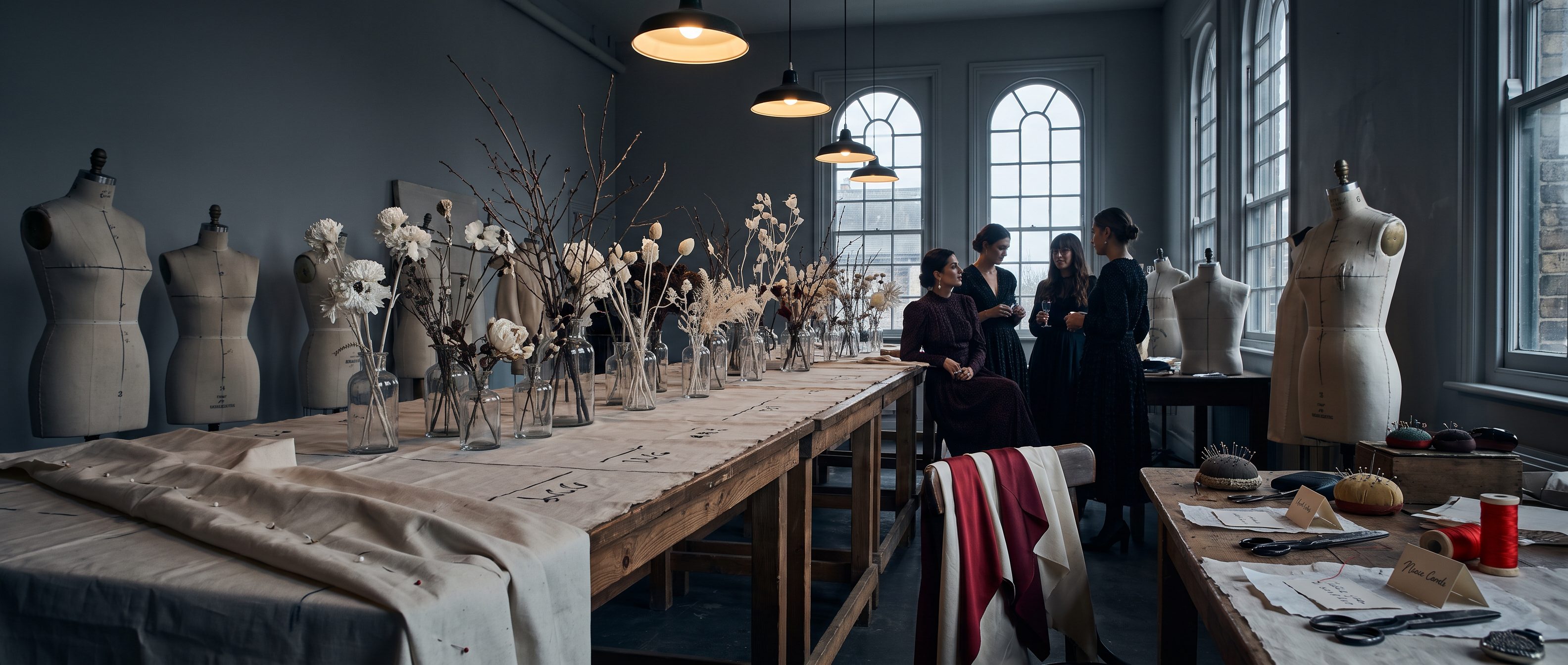
Cloth is chosen for what it does under two different light temperatures about thirteen feet apart, which is this room’s real condition: a hard cool task light over the cutting table, everything else warm and dim.
Wool suiting, roughly nine to eleven ounces. The center of the wardrobe. It holds a pressed edge, takes the light without flaring, does not crease in a car, and looks the same at eleven as it did at seven. Anything under about eight ounces is summer cloth and collapses across the back after two hours in a chair.
Cotton drill, twill and moleskin. The workwear end, and the honest way to use cotton here instead of calico. Drill has body, takes a crease, and photographs as structure rather than as laundry. In Pattern Brown it is the best single garment in the whole scheme.
Silk, on the bias. Bias is the technique this evening actually respects — cut at forty-five degrees to the warp, the cloth gains stretch it does not have on grain, and it follows a body without a single dart. A bias silk dress in Bias Silk Shadow is the one genuinely luxurious thing in the room, and it earns it, because bias is difficult to cut and impossible to fake. Warning attached: bias hangs and grows for days, so it is not the garment you buy on the Thursday.
Silk organza. The couture underlining: crisp, transparent, almost weightless, and it reads brilliantly against a cool source. As a whole garment it is a costume. As a collar, a cuff or a facing turned out, it is the cleverest small move available.
Linen. Allowed, with a condition: heavy linen only, about nine ounces and up, and pressed. Light linen creases into exactly the “tired” register this room cannot afford, and once it does you cannot get it back in a room that has no iron.
Things that fail here. Satin-face anything flares white under the task light and looks wet. Sequin reads gray under a flat cool source and gold thirteen feet away, so you flicker. Cheap viscose crepe goes slack across the seat by hour two. Velvet is too warm and collects loose calico fluff, of which there will be a great deal. And optically brightened white goes blue-violet next to warm ecru and makes the room look dirty.
The cheap material that reads expensive: heavy cotton drill, properly pressed, in a strong plain color. It costs very little and it holds a shape better than most silk.
Keep the Palette Quiet Enough to See the Work
The room’s twelve colors do not transfer to bodies at the same ratios. Raw Calico is seventeen percent of the room and should be zero percent of the guests. That is the rule. Wear the wall color and you become the wall — this room is unusually good at absorbing people, and a guest in ecru at a table dressed in ecru is furniture with a face.
The colors that belong on a body are the marks, not the ground. Graphite Line and Ink Notation carry the pencil — a soft warm charcoal and a near-black with a blue cast — and both are better here than true black, which sits in front of everything else as a hole. Pattern Brown is the sleeper: exactly the color of the paper a pattern is cut in, good on the widest range of skins under warm light, and it does not die under the cool one. Tailor Chalk Blue is the accent that reads as chalk, which is to say slightly dusty.
Thread Red is two percent for a reason. It is tacking thread. On a person it means a single element: a lip, a nail, a hand-run line of stitch along a cuff, a shoe. Two red things is a decision. Three is a scheme, and a scheme is exactly what this room is arguing against.
What the room does to skin: the warm dim end is flattering to everybody and unhelpfully so, and the cool task pool at the other end is not flattering to anybody, including the ceiling. Nobody looks bad in it; everybody looks accurate in it. Dress for the accurate light and the warm light will take care of itself.
The looks

One — The Fitting Stance
A plain dark dress or a plain dark two-piece, in wool, that has been altered to the person wearing it. That is the entire look and it is the best one on this page. No print, no detail, no jewelry beyond one thing. The shoulder sits on the bone, the waist sits where the waist is, the hem is where it was decided rather than where it arrived. In a room built on fit, arriving in something that fits is the loudest possible statement and it costs the price of an alteration.
Two — Seam Allowance Out
A jacket or overshirt whose seam allowances have been pressed open and bound on the outside, in a contrast tape — Pattern Brown binding on graphite, or chalk blue on brown. This is Hong Kong binding, an ordinary couture finish for the inside of an unlined jacket, moved to the face of the garment. It is one afternoon’s work for somebody competent, it can be done to a jacket you already have, and it is the only literal quotation of the workroom I will allow, because it is a finish rather than a fancy dress.
Three — The Basting Line
From the wardrobe. A white or ecru shirt, good and pressed, dark trousers, flat shoes. Then, before you leave, run a line of long white or red running stitch by hand along one edge — the outside of a cuff, the top of a breast pocket, the placket. About two and a half inches. Uneven on purpose, because basting is. It takes four minutes, it costs nothing, it is the single detail that makes a plain outfit belong to this evening and no other, and it is removable with a snip on Sunday.
Four — Half a Sleeve
Tailoring worn with the sleeve basting still in: the white tacking a tailor runs through a vent to hold it flat in transit, which the wearer is meant to cut out. Here it stays in on purpose. Add a wool trouser, a plain crew-neck under, no tie.
Five — Chalk Blue, Non-Gendered
An oversized chalk-blue shirt in heavy cotton — the shoulder dropped on purpose, one place, the only place — over a narrow graphite trouser and a soft boot. The shirt is the volume; nothing else is. A chalk blue this dusty is difficult to find and easy to approximate: a well-washed pale denim shirt in a plain weave, pressed properly, does the same job. Bare neck, one steel bracelet, no belt.
Six — Bias, Once
The single extravagance. A bias-cut silk column in Bias Silk Shadow, a warm gray-brown that behaves like a shadow rather than a color, with a flat shoe and a wool jacket thrown over — never a bolero, never anything cropped and matching. Bias shows every seam of what is worn underneath, which is a decision to make in daylight and not in an elevator.
Seven — The Second Wearing
From the wardrobe, and the point of the whole exercise. Take the garment you wore to the last three of these, the one you like and no longer quite trust, and have one thing changed: the sleeve shortened, the waist taken in, the shoulder pads removed, the hem re-set. Wear it. Tell nobody. It will read as new to everybody in the room, including you, and it will have cost less than the taxi.
Accessories, jewelry, shoes, bags
Metal is steel and it is small. Pin Steel is three percent of the room and it is the right note: a flat bangle, a thin chain, small hoops. Gold works if it is warm, matte and singular; polished yellow gold in quantity fights Wax Yellow. No pearls, which read as the finished version of a person and are wrong here for reasons that are not about pearls.
Scale is set by the table. Guests lean on their forearms within the first half hour, so a bracelet is either flat or it is a percussion instrument for four hours. Earrings survive a hug or they are not worn.
Shoes deal with a floor that has been swept for pins and will be swept again. Flat, low or stacked; no stiletto tip, because a fine point finds a board gap and a board gap here may also be holding a pin. Soles matter more than uppers — a plain leather sole on swept boards is slippery, and this is a room where people get up and walk about.
Bags: there is nowhere to put one down, because every horizontal surface is either cloth to be protected or a working table. So a bag hangs on the body, holds a phone, a key and a lipstick, and has no chain strap to lie on the calico and mark it.
Hair, face and hands — the short version
Skin is satin. Not dewy, which reads as sweat under a hard cool source, and not fully matte, which goes chalky in warm dim light. The emphasis is on edges, not washes: a defined lash line rather than a haze of shadow, a clean lip line, one thing that is a color and everything else that is a finish.
Hair is pinned and the pins are visible, which is the correct joke and the only permitted one — bobby pins that are doing a job, placed deliberately, not the studied fallen-down version. A low knot, a flat pinned wave, a chignon with the ends left out. Nothing that has to be checked in a mirror at ten.
Nails are short, filed square with the corners taken off, in one of three finishes: bare and buffed, a bone or greige that reads against calico rather than into it, or the single Thread Red. Hands are at cutting-table height all night and photograph more than faces at this particular dinner.
The whole method — the timeline, the two light temperatures, what holds at hour five and what does not — is set out in the beauty companion on Vanity or Vice, at Two Lights, Four Meters Apart.
The Host Is Not the Finished Sample
The host has a problem here that is specific to this concept and it is not about fit. There is a maker in the room being paid to work, in their own working clothes, and if the host is dressed like a client the maker becomes staff. It cannot be solved by dressing the maker up, which is patronizing, nor by the host dressing down, which is a costume in the other direction.
It is solved by dressing across. An apron is genuinely correct here — in heavy drill in Pattern Brown, cut long, over a dark shirt and trousers, with a pocket that holds snips, a pencil and a phone. It reads as somebody who works, because they do, and as designed, because it is. It also solves the host’s logistics: pockets, no sleeve to catch, nothing pale at hand height, something you can wipe.
The principal — the couple, the birthday, whoever the night belongs to — is made visible by being the only person in the room wearing a finished thing. Everything else is proposal. They are the resolved version. That is a much better instrument than a sash and it requires exactly no props: one person in a garment that is unambiguously complete, in a room where nothing else is, and everybody works it out in about nine seconds.
Tell Guests the Clothes Are Allowed to Be in Process
The invitation line:
Nothing new. Bring one thing that fits, or one thing you have had altered. Marks welcome.
The honest translation, which goes underneath in smaller type or in the reply, because “nothing new” without translation produces four people in gardening clothes:
This is a dinner, and it is dressed. Wear the good dark thing. The instruction is not to buy anything for it and not to arrive in anything that does not fit you properly, which is a request to spend a small amount of money on an alteration rather than a large amount on a garment. If a hem has been let down or a shoulder taken in, leave the chalk mark in. Do not wear cream, ecru or oatmeal; you will disappear into the table.
Somebody will ignore all of this and arrive in a new dress in exactly the color of the tablecloth. Nobody says anything and nobody is corrected at a door, ever. The fix is a seat: put them at the end nearest the cutting light, where the cool source separates them from the cloth, and the problem disappears without a word.
Turning the Guest Into the Garment Is the Failure Mode
The costume version is calico. Somebody will suggest calico sashes, calico wraps, calico as a dress code, and they will be able to explain why it is clever. It is clever. It also puts sixty guests in the same cloth as the chairs, and a room where the people and the furniture are upholstered in the same material is a hotel lobby.
The second failure is fray. Raw edges on clothing read as damage rather than as process, and process is the point. A cut edge is fine; a fluffed one is a garment coming apart in public. Pinking shears are not a design decision.
The third is over-notation. One person with a chalk mark on a shoulder is a joke that lands. Twelve people with chalk marks is a school play about a tailor’s shop. Whoever is doing the marking — and it should be one person, once, at the door, and only for people who ask — needs to be told to stop long before they want to.
And the accessory that cheapens it every time is the novelty pin: an oversized safety pin, a pin cushion as a corsage, a tape measure around a neck. The room already holds hundreds of real pins doing real work. A fake one in jewelry form is the difference between a workroom and a themed restaurant.
What you want, at the end of the night, is a room where nobody could tell you what anybody was wearing, and everybody could tell you who looked right.
The food for the same evening is in the menu: Cheap Cloth, Expensive Labor.
Atmosphere OS · Theme Atelier
Turn the mood into something a florist can quote.
Theme Atelier builds palette, materials, lighting and spatial mood into one system, then writes it in language a vendor can price. Every number it produces comes from a published rule, and the rulebook names the judgments it deliberately refuses to call rules.
Costs come back as indicative bands rather than quotes, and seasonal notes are filters rather than promises.
Field notes and corrections
When a number here turns out to be wrong, you hear about it.
Three things arrive and nothing else. The new field note — bar rates, cover widths, service clearances, the arithmetic worked through on one real evening. A line when a new World or Mini Occasion opens, because a night only goes up once it can actually be thrown. And a correction whenever a rule in the published rulebook changes, or a number the tools rely on turns out to have been wrong. There is no weekly slot, because there is nothing weekly to put in it.
One email per field note or opening, plus corrections when a published figure moves. Unsubscribe from any of them.
Continue through the system
Pretty is still not a plan.
A party gets planned in roughly this order. Pick the chapter where your next problem lives.
What you have to decide next
One decision constrains the next. This is the order they actually happen in.
- Venue Will this room hold it? The Serpentine Table Is Eleven Percent Longer Than the Spec Sheet Says
- Guest experience How will guests move through it? The Place Setting Fits. The Person Does Not.
- Production How does it get built and run? The Event Needs a Failure Mode That Still Looks Intentional
- Vendors Who owns each handoff?
More in this chapter

See the complete five-chapter Event Design Intelligence map →
You must be logged in to post a comment.