Space & Venue Reality
The Pool Isn’t the Party. It’s One Loud Guest Everyone Has to Plan Around.
A pool changes sound, supervision, seating, food, clothing and the guest list even when half the people never get in. Build wet and dry social zones so the water participates without taking over the whole event.

A pool has main-character energy.
It sparkles in photographs. It makes an ordinary backyard look like something is already happening. Children spot it before they spot the birthday cake. Adults begin making calculations about shoes, hair and whether ‘pool party’ means they were actually expected to swim.
Then the host makes the classic mistake: because the pool is visually dominant, the pool becomes the plan.
It is not.
The pool is one very loud guest at the party. It changes almost everything around it, including the experience of people who never put a toe in the water.
Safety is not a zone you decorate later
When children are present, water supervision has to be explicit. The CDC recommends close and constant supervision of children in or near water and advises designating a responsible adult who is not distracted by a phone, reading, alcohol or other activities. It also recommends four-sided fencing that separates a home pool from the house, with self-closing and self-latching gates.
That means ‘there are a lot of adults outside’ is not a supervision plan.
If children will swim, decide who is watching the water and when that responsibility changes hands. If swimming ends, close and secure access according to the pool’s safety setup rather than assuming the party has moved on and therefore the risk has too.
It is entirely possible to have a beautiful, relaxed pool event without being casual about this.
Build a dry party before you build the wet one
Where does a guest who is not swimming sit?
Not the chair receiving splash from three directions. Not the towel bench. Not the lone table twenty feet away that makes opting out feel like leaving the event.
Create a real dry social area within the same general atmosphere: comfortable seating, shade where needed, access to drinks, a view of the action without being inside it.
This is especially important for mixed groups. Some people cannot swim. Some do not want to. Some are dressed for the dinner portion. Some will be in the water for two hours. Nobody should have to declare a position on swimming in order to belong to the party.
The dry zone is not spectator seating. It is half the event.
Wet bodies need a route
The person getting out of the pool is carrying water with them.
Where is the towel? Where are their shoes? Can they reach the bathroom without crossing the living room dripping? Is there a place to sit that can tolerate a wet swimsuit? Does the door become a slippery threshold after five trips?
Map that route before the party.
Keep towels close to the exit point from the water, not in a decorative basket across the yard. Provide a clear place for wet towels rather than letting them colonize every chair. Protect indoor floors if guests need to go inside. If there is an outdoor shower or changing area, make its use obvious and private enough to be useful.
Water migration is inevitable. Random water migration is optional.
Food should not compete with cannonballs
The pool edge is not a buffet line.
Put food far enough from splashing, wet traffic and active play that somebody carrying a plate is not entering the same lane as somebody running toward the water. Follow your pool rules about drinkware and keep breakable glass away from the pool area; use appropriate pool-safe serving pieces and cups instead.
Then think about appetite and timing.
A swimming-heavy afternoon often works better when food can be eaten in waves instead of requiring every guest to dry off simultaneously for a formal meal. If dinner is a real transition, make it a transition: towels, dry clothes if needed, lighting shift, food moved to the table, the pool becoming background rather than remaining active chaos six feet away.
The evening is allowed to change modes.
Sound behaves differently beside water
Pools are noisy before the speaker turns on.
Water, hard paving, excited voices and open air can produce a surprising amount of sound. If you add music, start lower than you think you need. Stand in the dry seating area and try to have a conversation. Then stand at the property edge.
A playlist should support the event, not compete with splashing for acoustic custody of the yard.
This also matters if the pool stays visually active after swimming stops. Quieter sound can help announce the turn better than a speech about how ‘we’re moving into dinner now.’
Shade is social infrastructure
The sun decides where people are willing to sit.
If the only shade is one umbrella over a table for four, those four seats will become the most important real estate at the event. Plan shade for people who are swimming and people who are not. Remember that shade moves while the party stays put.
And do not let the pretty lounging area occupy the path around the water. Poolside furniture needs to support circulation, not create an obstacle course with cushions.
Keep the pool visible without making every seat face it
This is the spatial trick that keeps the party from becoming a swim meet.
Some seating should have a view of the water, especially where supervision matters. But not every chair needs to be pointed at it.
Create conversation clusters angled toward each other. Give the non-swimming group a real focal point: flowers, food, fire later if safely located elsewhere, a beautiful table, the view beyond the yard.
The pool can remain present without being the only thing the room knows how to look at.
The end of swimming needs an actual end
One of the messiest pool-party transitions is the indefinite one.
Half the group is dressed. One child is still swimming. Towels are everywhere. Dinner is technically ready. Someone has put their shoes on and immediately stepped into a puddle.
If the event has a second act, decide when swimming closes. Give people warning. Provide enough time to dry off and change if needed. Reset the wet zone rather than carrying its debris into dinner.
The afternoon can stay loose. The next part of the event just deserves a chance to exist.
A pool is a spectacular atmosphere carrier. It gives light, movement, sound and instant permission to relax.
It also brings water, risk, noise and a very strong opinion about where everybody should look.
Let it be one important guest.
Do not hand it the microphone for the entire night.
Safety source: CDC, Preventing Drowning.
Related reading: The Guest Experience Starts in the Parking Lot · The Patio Is Not the Overflow Room · How Many Event Staff Do You Actually Need?
Space Lab
Build the room once. Keep testing it.
Space Lab keeps dimensions, ceiling, obstacles, published capacity and their evidence basis together in one room record, then uses that same room for fit, clearance, flow, turnover, comparison and site-visit questions.
It shows planning estimates as estimates and keeps legal occupancy, venue approval and other authority decisions outside the calculator.
If this is your mood
More daylight
 ArticleBrunch Has Different Manners Than Dinner
 ArticleThe Casual Lunch That Accidentally Acquired a Creative Direction
 ArticleThe Clothes That Did the Whole Summer
 ArticleBrunch for Ten: Coffee Is the First Service Problem
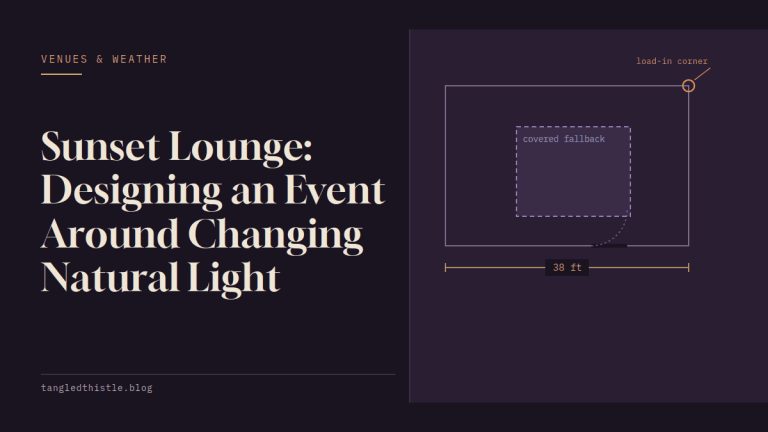 ArticleSunset Lounge: Designing an Event Around Changing Natural Light
 ArticleThe Glass-Greenhouse Event: Beautiful Light, Difficult Temperature
 ArticleField Day for Grown-Ups: Competition Without Making It Gym Class
Field notes and corrections
When a number here turns out to be wrong, you hear about it.
Two things arrive and nothing else. The new field note — bar rates, cover widths, service clearances, the arithmetic worked through on one real evening. And a correction whenever a rule in the published rulebook changes, or a number the tools rely on turns out to have been wrong. There is no weekly slot, because there is nothing weekly to put in it.
One email per field note, plus corrections when a published figure moves. Unsubscribe from any of them.
Continue through the system
Pretty is still not a plan.
This field note belongs to a larger event-design system. Follow the chapter that explains the next pressure point instead of falling back into an undifferentiated archive.
What you have to decide next
One decision constrains the next. This is the order they actually happen in.
More in this chapter

See the complete five-chapter Event Design Intelligence map →