Space & Venue Reality
Sunset Lounge: Designing an Event Around Changing Natural Light
Sunset is not one lighting condition. It's a sequence, and it ends in a room that behaves nothing like the one everyone approved during setup.
Sunset is not one lighting condition. It is a sequence: bright exterior light, longer shadows, warmer color, rapid loss of contrast, and then an after-dark room that may behave nothing like the one approved during setup.
A sunset-led event works when the design is built for that change. Guests should not spend the most beautiful part of the evening squinting into glare, then discover that menus, paths, and table numbers disappear twenty minutes later.
Start with the site orientation and actual event date
Use date- and location-specific sunset information close to planning and confirm how the venue’s buildings, trees, mountains, landscape, or neighboring structures affect the visible light. The listed sunset time does not tell you when a particular terrace falls into shade or when the last useful daylight leaves a courtyard.
Walk or photograph the site around the event hours when practical. Note direct sun on guest seating, glare toward the ceremony or program position, the point where tables become shaded, and which routes become difficult first after dark.
Give guests a comfortable relationship to the sun
A dramatic western view can be extraordinary and uncomfortable if every chair faces low sun for a long stationary segment. Consider orientation, shade, seating duration, eyewear, temperature, and whether guests can choose a more protected position without leaving the event.
Where the view is the hero, use the layout to preserve it without requiring every guest to look directly into it. A slight rotation, lateral seating, a shorter program, or moving the longest conversation period until the light softens can protect both the landscape and the people experiencing it.
Use materials that change gracefully with the light
Warm wood, stone, linen, smoked glass, muted metallics, foliage, and soft floral color can respond beautifully as daylight changes, but no material behaves identically in every setting. Test the principal palette under bright daylight, late sun, and the planned artificial lighting state.
A dramatic western view can be extraordinary and uncomfortable if every chair faces low sun for a long stationary segment.
A pale surface may become luminous at dusk and overly bright under a nearby fixture. Dark glass may feel sophisticated in daylight and disappear later. Reflective objects can catch the sunset and then begin reflecting the room after dark. Design for both versions.
Keep florals low where the horizon is the visual asset
If the site’s principal value is a view, large tabletop florals can compete with the reason guests are facing that direction, for the same reason an arrangement at eye level competes with the person across the table. Consider lower mass, more directional line, floor-level botanical moments, or concentrated arrangements at the bar, entrance, or other positions that do not interrupt the horizon.
Let the florist determine suitable materials for sun, heat, wind, transport, and installation timing. Outdoor flowers should be selected for the conditions they must inhabit, not only for the palette they carry.
Build the artificial lighting before it is needed
The after-dark lighting plan should already be operating before guests begin noticing the loss of visibility. On a site that changes this much, lighting is the first design decision rather than the last. Layer useful light for paths, steps, signs, faces, tables, restrooms, service, and transportation with the atmospheric light that gives the evening its character.
Qualified lighting and electrical professionals should determine equipment, power, controls, weather protection, and installation. The creative plan should define the transition: what becomes more visible as daylight fades, what recedes, and which focal point takes over from the landscape.
Let the lounge become more important as the sky becomes less important
A sunset lounge works well when the social center strengthens as the natural spectacle passes. Earlier, furniture can face outward toward the view. Later, smaller seating clusters, pools of light, warmth, music, or a bar can pull attention inward.
This gives the event a built-in sequence instead of asking the sunset to remain the focal point after it is gone. The room develops rather than simply becoming darker.
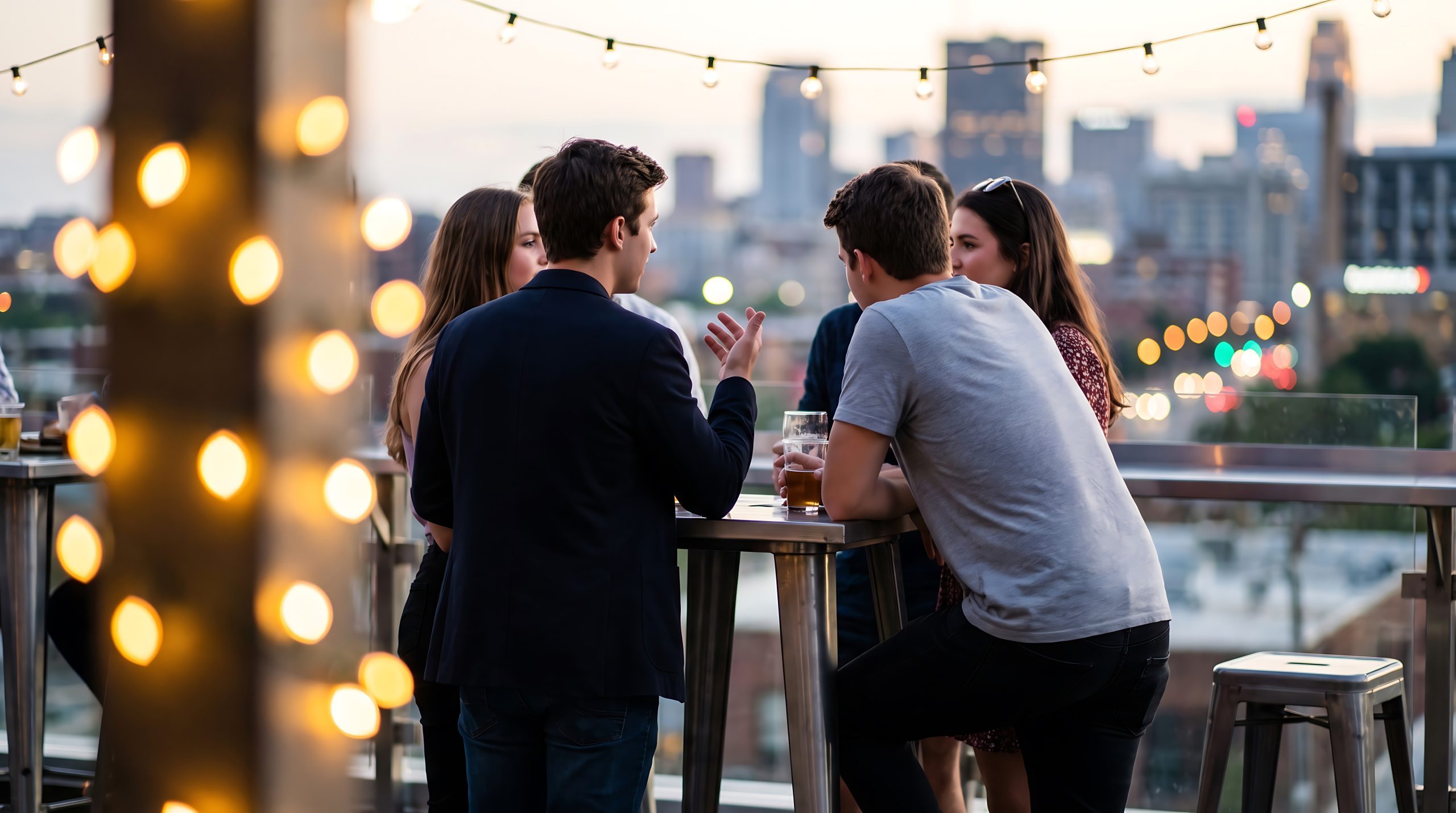
Plan temperature changes with the same seriousness as light changes
Sunset can coincide with a meaningful change in temperature, wind, or humidity depending on location and season. Use current weather information near the event and build guest comfort around the likely conditions rather than assuming the same furniture and clothing experience will remain comfortable all evening.
Provide appropriate shade, water, wraps, shelter, heated or cooler interior space, or professionally specified climate systems as the site requires. Safety and equipment decisions belong to the venue and qualified providers; the hospitality plan should make comfort resources easy to find and use.
Check the bar and service plan after dark
A service station positioned perfectly in daylight may become visually dominant after nearby lighting turns on, or difficult to operate if the route is too dark. Glassware, ice, replenishment, waste, and staff movement need useful light that does not destroy the guest-facing atmosphere.
Coordinate the service route and lighting plan so the event does not solve the staff’s visibility problem with one harsh work light suddenly aimed into the room.
Make paper and signage survive two lighting states
Menus, escort information, table numbers, and directional signs may be easy to read in daylight and difficult under low warm light. Test actual type, contrast, material, and placement after dark.
Do not make guests use a phone flashlight to decode a beautifully subtle menu. Low-light atmosphere and legibility can coexist when typography, scale, contrast, and local illumination are considered together.
Protect the weather version from becoming visually unrelated
If weather moves the event inside, identify what replaces the sunset’s visual job. That version has to be designed as its own event, because a rain plan is not a tent. Warm layered light, reflective material, an interior focal installation, or a darker palette can preserve the sense of transition without pretending the sky is still part of the room.
The alternate event should carry the same emotional sequence—soft arrival, deepening color, intimate evening—even if the landscape disappears.
Run the daylight-to-dark walk
- Where is direct sun at the event hour?
- Which seats experience glare or heat?
- What material combinations change most as light fades?
- When does artificial lighting become necessary for safe, comfortable use?
- What becomes the focal point after sunset?
- Can guests still read, navigate, and find transportation?
- Does the weather version preserve the same emotional progression?
Treat sunset like a deadline. The room still has to work for the two hours after it.
Design the hour after the photograph
The best sunset event does not depend on one perfect minute of sky. It uses changing natural light as the opening movement, then hands the room gracefully to artificial light, closer seating, deeper color, and a stronger social center.
Do not make guests use a phone flashlight to decode a beautifully subtle menu.
Plan the whole arc and the sunset gets to be the opening act, with nobody sprinting across the lawn to catch it.
Space Lab
The floor plan is a drawing. The license is a fact.
Start with the event you are actually planning and test the room against it. Space Lab does not claim that a date is free, a price is current or a license is valid; those remain direct-confirmation questions outside the room model.
Free to use, with one reusable room record shared across the spatial instruments.
If this is your mood
More daylight
Field notes and corrections
When a number here turns out to be wrong, you hear about it.
Three things arrive and nothing else. The new field note — bar rates, cover widths, service clearances, the arithmetic worked through on one real evening. A line when a World opens, because a night only goes up once it can actually be thrown. And a correction whenever a rule in the published rulebook changes, or a number the tools rely on turns out to have been wrong. There is no weekly slot, because there is nothing weekly to put in it.
One email per field note or opening, plus corrections when a published figure moves. Unsubscribe from any of them.
Continue through the system
Pretty is still not a plan.
A party gets planned in roughly this order. Pick the chapter where your next problem lives.
What you have to decide next
One decision constrains the next. This is the order they actually happen in.
More in this chapter

See the complete five-chapter Event Design Intelligence map →
You must be logged in to post a comment.