Design & Florals
The Clothes That Did the Whole Summer
Styling for Last Night of the Season, Occasion Study No. 25: what to wear to a terrace being taken apart around the dinner, and why the faded thing is the correct thing.
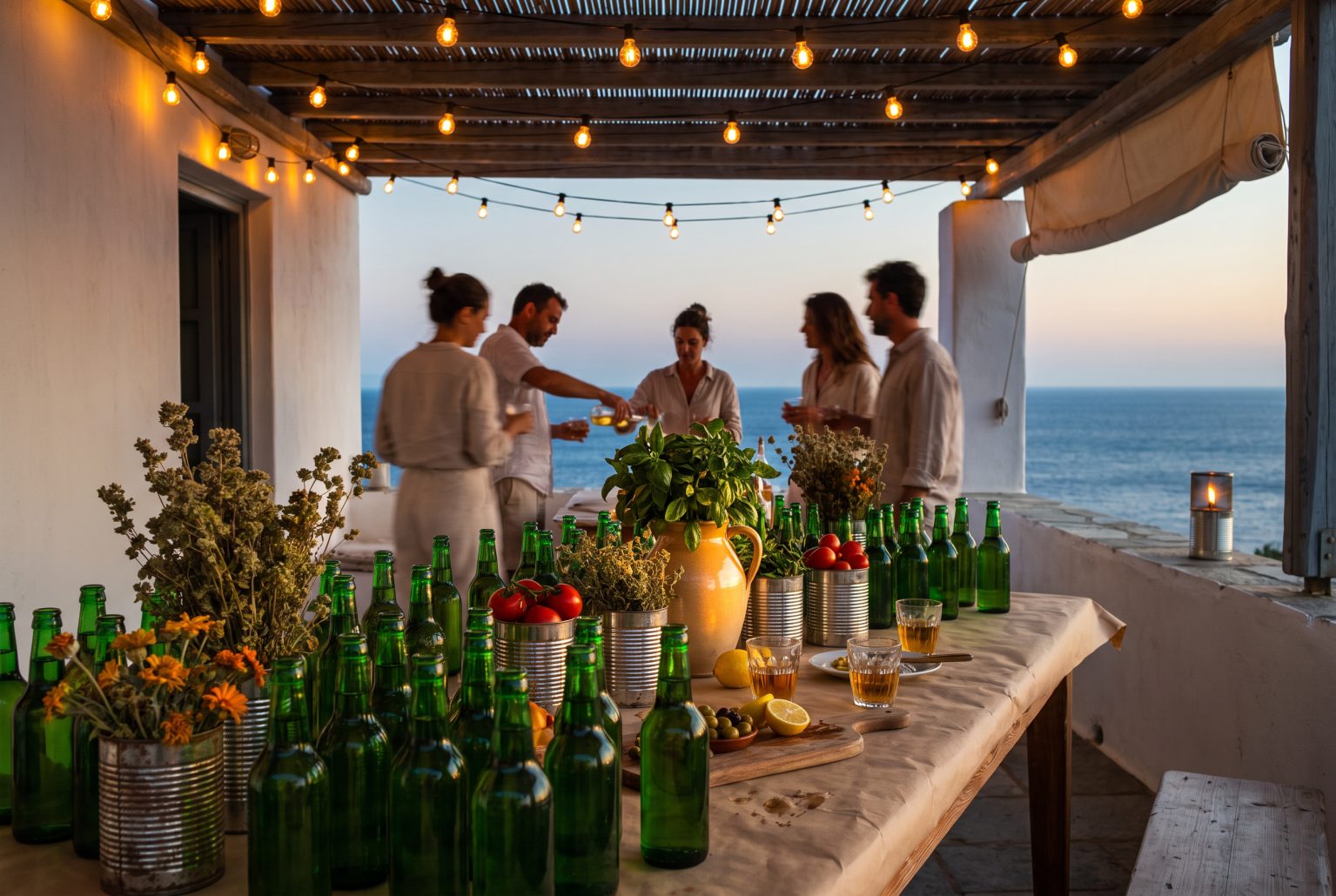
A seasonal place shutting for winter is one of the few occasions left where the clothes have a job. Not a dress code — a job. Chairs come down off the stacks and somebody carries them. The awning is already off its rail at the far end. There is dust that has been sitting on stacked seat-slats since June, and it transfers. This is the rare evening where the correct thing to wear is decided by the fact that you will end it holding something.
So this starts where the Occasion Study leaves the room: a terrace mid-dismantle, a cellar being deliberately drained, a hundred and fifty people at the outside. What follows is what people put on to be in it.
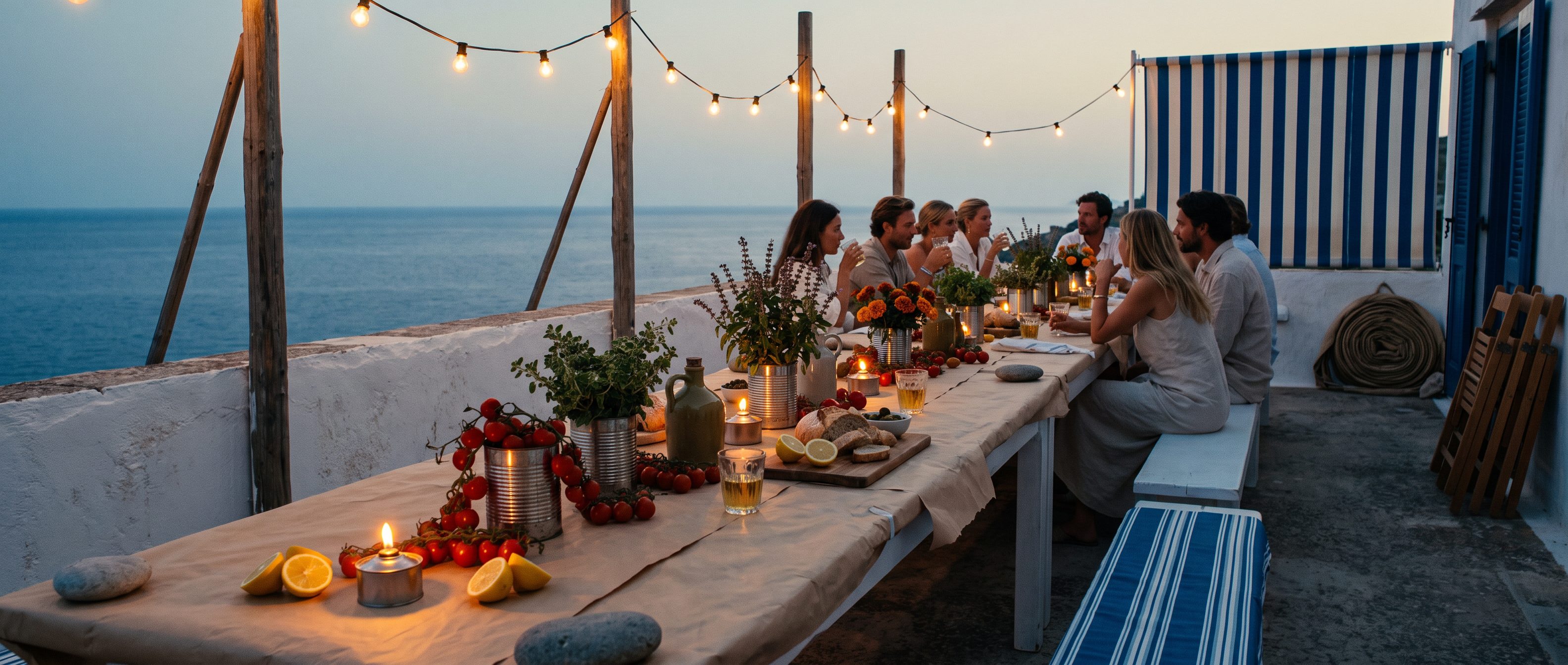
Dress for a Place Mid-Dismantle
The source is the closing ritual rather than anything Mediterranean. It exists wherever a place has a season, and it has one consistent property: it reports the outcome of the season rather than decorating it.
Take the Alpine cattle descent — Almabtrieb in Austria, Alpabzug in Switzerland — which happens in September, sometimes late August, sometimes into October, on a date set by the grass and the weather rather than by a calendar. The lead cows come down in an Almbosch: a headdress of evergreen, flowers and ribbon, with a heavy bell. It looks like festival dress, and it is actually a statement that the summer passed without loss. If an animal died on the mountain, the herd comes down undecorated, and everybody watching understands the sentence that has just been spoken.
That is the mechanism worth taking. The last night of a season is a report, and the clothes are part of it. What was worn all summer is worn once more, deliberately, in its faded and slightly wrecked state, because the fade is the information. The shirt that has been through eleven weeks of salt and sun is the correct shirt. It earned its color the way the cattle earned the flowers.
The other closing tradition worth naming is the Grand Hotel on Mackinac Island, which shuts on the last Monday of October by ringing a bell and carrying the rocking chairs in off the porch. The last guests and the last furniture leave through the same door. That is this evening’s choreography.
And here is what I refuse. Closing day at a ski hill is the other tradition, and it is fancy dress — pond skimming in neon and Hawaiian shirts, a thing Warren Miller was already filming at Mount Baker in 1954 and which Sunshine Village has run as the Slush Cup for the better part of a century. Genuinely fun; not this. I also refuse, as the concept itself insists, the costume version of somebody else’s country: the fishing nets, the blue-and-white bunting, the linen-and-espadrille postcard, and above all putting staff in folk dress so guests can photograph them. Borrow the ritual. Never the fancy dress. Never the locals as scenery.
The Line Needs to Lift, Carry and Sit
Three physical facts set the silhouette: you will carry something, the wind reverses after dark, and you will sit on a chair that has spent two months in a stack.
Carrying settles the arms. Sleeves want to push above the elbow and stay there, which means a cuff with a button or a genuinely loose sleeve — not a half-sleeve that binds at the bicep the moment you lift a crate. Volume goes into the body, not the hands. Nothing trailing. If a shawl requires a hand, it is not a shawl for tonight, it is a prop.
The wind reverses because land cools faster than water: the afternoon breeze comes off the sea, and after sunset it turns and comes off the land, colder and steadier, straight down the terrace. Every seasonal place has a direction it does this in and every regular knows it. So layer from the start rather than rescue later. The top layer should be present at eight while it is still warm, doing something visual, not hanging on a chair-back like an apology.
Hems clear the ground by a decided margin. Decking has gaps, terraces have grit in the corners, jetties have a wet strip you cannot see at night. Mid-calf reads better here than floor or knee, because it moves and it survives. Trousers: wide, flat-fronted, ankle-clearing, cut so three hours on a hard chair does not make the waistband the evening’s subject.
Then the chair test, which is what actually decides. Stacked outdoor chairs deposit dust, spider silk and a grit of paint flake on the back of the thighs. A dark, smooth-faced cloth brushes clean; a pale linen keeps it. I am not arguing for black, only for knowing what the back of your outfit is doing.
The cloth
Everything here is either washable or already ruined, and there is real dignity in the second category.
Cotton poplin and chambray. The workhorses: right weight for a warm evening, enough body to hold shape once the wind turns. Chambray that has faded unevenly across a summer beats new chambray, and this is one of the very few evenings where that is literally true rather than a fashion sentiment.
Heavy linen, not fine linen. Fine linen creases in a car and reads crumpled by nine. Heavier linen — trouser and jacket weight rather than shirting — creases into folds that look intentional under a low sun, and it dries fast, which matters near water.
Dry-spun wool over cotton knit. The evening’s real problem is the two-hour drop after sunset. A cotton knit is warm enough at nine and useless at eleven; a dry-spun lambswool handles both. Cashmere is the wrong answer, not because it is expensive but because it takes salt air and outdoor smoke and holds them for a week.
Canvas and drill. A chore or deck jacket in cotton drill is the single most useful garment on this terrace. It takes the dust, it has pockets, it goes over anything, and it looks better dirty.
What to avoid. Satin-faced anything, which shows every splash, and there will be splashes, because the plates come out at once and get passed. Anything sheer under festoon lighting, because warm bulbs strung above head height backlight a body and a fine voile stops being a garment. Beadwork, which snags on trestle edges and crate handles. And anything dry-clean-only, on a night whose premise is that nothing is held back for next year.
One thing that looks expensive and is not: heavy cotton twill, well pressed, in a color that has gone slightly chalky. Under a warm bulb it photographs like raw silk and it costs what a work trouser costs.
Use the Colors the Building Has Left
The room is already doing the palette. Sun-bleached Blue at sixteen percent and Whitewash at fifteen are the walls and paintwork; Driftwood at fourteen is the timber and the stacked furniture; Evening Sea at thirteen is what is behind everybody after nine. Those four are the setting, and a guest wearing all four disappears into it.
What belongs on a body: Evening Sea (#23506B), the strongest thing a person can wear here, reading as almost-black against the water without the deadness of black. Driftwood (#B4A48C) for anything tailored, because it is the exact non-color that stops a linen suit looking like a holiday. Oregano (#6F7A4A) at seven percent, under-used in the room and therefore available — a deep herbal green is the most flattering thing on a terrace at dusk against skin that has been outdoors. And Late Tomato (#C0392B) or Awning Stripe (#D96A5A) on one person, or one scarf, and not on four, because at nine and eight percent those are accents.
What stays in the room: Paper Cloth (#EFE8D8) and Whitewash (#F2EFE7). They are the table and the wall, and they photograph at the same tone as the paper, so every picture ends up containing somebody who appears to be wearing the tablecloth. Retsina Glass (#C6CBA8) belongs to the glassware; on a person it goes gray the moment the light drops.
Avoid Sun-bleached Blue at garment scale outright. It is the biggest color in the room, it is on the shutters and half the crates, and a mid-blue shirt in that family reads as staff or as camouflage depending where you stand. Wear the dark blue or a different blue. Last-light Gold (#F2A93B) is the sunset itself, lasts about twenty minutes, and should be borrowed in metal or one small object. It is a light, not a fabric.
The looks
1. The Shirt That Did the Whole Summer
Assembled from things already owned, and the closest thing this evening has to a correct answer. A cotton or chambray shirt genuinely worn all season and faded unevenly at the shoulders, sleeves rolled below the elbow, loose over wide flat-front trousers in heavy cotton in Driftwood. Leather sandals or canvas sneakers with an actual sole. A knit that goes on properly at ten rather than being draped decoratively at eight. The detail that makes it this world: the shirt is not pressed. Pressing it would be a small lie about the season.
2. The Deck Jacket
For anyone who is going to help and knows it. Cotton drill chore jacket in Evening Sea over a fine knit, straight trousers, boots or a substantial sandal, nothing at the neck. The pockets are load-bearing: phone, flashlight, the corkscrew that keeps disappearing. This is the look that ends the night carrying the last two chairs, and it is the most attractive thing on the terrace at midnight for exactly that reason. It works on any body and any gender without adjustment, which is unusual and worth saying.
3. Mid-calf, in a Fabric You Can Hose
A mid-calf dress or skirt in heavy washed cotton or heavy linen, cut with real ease through the hip so it survives a hard chair, in Oregano or Evening Sea. Flat sandals with a back strap; a mule is a mistake on decking. A long dry-spun cardigan in Driftwood over the top. One piece of warm metal at the ear. The detail: the hem is allowed to get wet, and knowing that in advance is what makes the wearer relaxed for four hours.
4. The Trouser Suit, Unbuttoned
Heavy linen or cotton twill, jacket and trouser, in Driftwood or a soft Tin Lamp gray (#8A8577), over a plain cotton t-shirt or a soft-collar shirt, no tie, jacket open all evening. This reads as having made an effort without having dressed up, which is the register the night wants. What keeps it out of the postcard: no pocket square, no espadrille, no rope belt. A worn leather belt and a shoe that has been resoled.
5. Everything Borrowed From the Bottom of the Bag
Also assembled from what exists, and the honest look for anybody arriving straight off a boat, a bus or a beach. Swim-damp hair, a long-sleeved cotton top, wide drawstring trousers, bare ankles, sandals. Then one deliberate thing on top — a heavy overshirt, a proper knit, a scarf in Late Tomato — which converts the whole assembly from underdressed to composed. That single layer is the entire trick, and it costs nothing if you already own one thing you like.
6. The Long Knit and Nothing Else Trying
A heavy oversized knit in a cream near Whitewash over a narrow dark trouser or straight dark skirt, with a substantial flat shoe. Deliberately monochrome and deliberately warm, for the person who runs cold and does not want to spend four hours negotiating with the wind. Because the outfit is quiet, one object — a cuff, a heavy ring, a good watch — does all the work, and it should be metal that has been worn rather than metal that is new.
7. The Half-Packed Look
For the host’s family, for staff who have become guests, for anyone who has been here since Tuesday. Work trousers, an apron taken off and left on a hook in view of the table, a clean shirt put on twenty minutes ago over the same trousers that did the shift. Nobody assembled it as a costume of labor; it is simply what happens, and it is the most correct thing anybody wears all night. If you are not that person, do not dress as them.
Accessories, jewelry, shoes, bags
Shoes decide everything. The surfaces are decking with gaps, gravel, poured concrete sloping to a drain, and possibly a slipway wet in a band you cannot see after dark. Heels are out, not on grounds of formality but because a stiletto goes through decking gaps and a block heel skates on wet concrete. Flat, backed, with grip: sandal with a heel strap, canvas sneaker, loafer, boot. Bare feet at midnight are likely; bare feet at eight are a decision about other people’s plates.
Jewelry is warm metal, and few pieces. Salt air dulls silver in one damp evening; brass and gold hold up and look right under a festoon bulb. Scale it against a low table and a lot of leaning. Earrings should survive a hug, because there will be many. One heavy piece beats four light ones, and nothing that needs guarding.
Bags. There is nowhere to put one down: the floor is dusty, the chairs are moving, the table is covered in every dish at once. Crossbody, or a small bag that stays on the body, or nothing at all and use the jacket. A clutch occupies a hand for four hours on a night when you need both.
Outerwear is part of the look, not luggage. Because the wind turns, the top layer is seen for three hours. Bring the one you would be photographed in, and bring it yourself: the venue is emptying, so there is no coat check, and there was probably never a coat check.
Leave behind: sunglasses on the head after nine, a hat that has been indoors all day, anything white and structured, and a scarf that needs re-tying, because it will need re-tying eleven times and you will stop enjoying yourself.
Hair, face and hands — the short version
Hair is worn in the shape the wind is going to make of it anyway. There is no fixing it later: there is no mirror, the bathroom light is a bare bulb, and by ten the building may be running on a single circuit. So the shape is loose, off the face at the front, and secured somewhere it can be re-secured by feel — a clip findable in the dark beats a pinned structure one gust from a full reset.
Skin keeps some sheen. The light after sunset is warm, low, and coming from bulbs above head height, which is kind to a surface with texture and merciless to anything powdered flat. Emphasis sits on the eye rather than the lip, because there is a great deal of eating and the lip will not survive it. Nails short and clean, bare or a color that is not trying: hands are in every photograph of a table where all the dishes arrive at once.
The full method — what actually holds for five hours in salt air with no mirror and no touch-ups — is in the beauty companion on Vanity or Vice, where the timeline and the honest wear reality live.
The Host Still Has Work to Do
The host is running a shutdown that happens to have a dinner in it. They will carry hot things, move furniture, and at some point go and find the flashlight. And if the collaboration is working, they will be the last person standing while the staff sit down, which the study treats as the whole point of the night.
So: pockets, decided in advance. Two, real, big enough for a phone and a folded list. A chore jacket, a work-cut trouser, or an apron worn as clothing rather than as service uniform. Sleeves that stay pushed up without help. A closed shoe with a sealed sole that can go into a wet kitchen and back out.
The host reads as the host through consistency, not decoration: the same thing all night, in one color that appears nowhere else on the guest list. A single strong Evening Sea in a room of Driftwood and cream means a hundred and fifty people can find them from anywhere on the terrace without anybody being labeled. That is what a sash is for, done better.
For a principal — a couple, somebody being sent off, whoever the night belongs to — the reverse: the only person in the warmest color in the palette, or the person holding the one object everybody else can see, which on this night is usually the last bottle off the list. Visibility through an object is more graceful than visibility through a garment, and it can be put down.
Tell Guests They May End the Night Holding Something
The invitation line, in this room’s register:
The terrace closes on Sunday. Come and help us finish it. Wear the thing you have worn all summer — there will be dust, there will be chairs to carry, and the wind turns at nine.
The honest translation, in the follow-up message and never as a list of rules: layers, flat shoes, nothing you would be upset to get dirty, and bring your own coat because there is nowhere to leave one. Facts with no adjectives beat “smart casual” every time, because “smart casual” is the phrase that produces a heel on decking.
Somebody will ignore all of it and arrive in the full evening version. The answer is never a correction and never a joke at the door. It is a chair carried over for them, a jacket offered at ten when the wind turns, and a real welcome, because a guest who has overdressed has overdressed for you. Nobody is turned away, adjusted or told what the invitation said. If somebody arrives in the wrong shoes, the fix is that somebody else goes barefoot too.
Looking Too Finished Is the Wrong Note
The costume version is the postcard: white linen head to toe, a straw hat indoors, a rope belt, espadrilles, and somewhere a striped thing. It is the outfit of a person who came to look at the coast rather than to be on it, and it reads as tourism at an evening whose subject is a place people actually work in.
The over-matched version is the whole table in Whitewash and Paper Cloth, which resolves in photographs into one beige field with heads floating in it. Three near-whites in a room is atmosphere; nine is a laundry.
The accessory that cheapens it every time is new white footwear. Under warm festoon light a bright white sneaker glows blue against every other surface on the terrace, and because the wearer knows it, they spend the night keeping it out of the dust — which is to say, not helping.
Get it right and there is one image at the end: the last two chairs going in through the door, carried by somebody in a jacket with dust on the back of it, who has clearly been sitting down.
Atmosphere OS · Theme Atelier
Where the feeling stops being a photograph.
Theme Atelier converts a direction into a documented design system with the lighting and material consequences attached. It runs in your browser and stays there until you decide the project is worth saving.
Costs come back as indicative bands rather than quotes, and seasonal notes are filters rather than promises.
If this is your mood
More daylight
 ArticleBrunch for Ten: Coffee Is the First Service Problem
 ArticleField Day for Grown-Ups: Competition Without Making It Gym Class
 ArticleBrunch Has Different Manners Than Dinner
 ArticleThe Pool Isn’t the Party. It’s One Loud Guest Everyone Has to Plan Around.
 ArticleThe Casual Lunch That Accidentally Acquired a Creative Direction
 ArticleThe Glass-Greenhouse Event: Beautiful Light, Difficult Temperature
 ArticleSummer Has Bad Manners
 Mini OccasionSun-Warmed Terrace
Field notes and corrections
When a number here turns out to be wrong, you hear about it.
Two things arrive and nothing else. The new field note — bar rates, cover widths, service clearances, the arithmetic worked through on one real evening. And a correction whenever a rule in the published rulebook changes, or a number the tools rely on turns out to have been wrong. There is no weekly slot, because there is nothing weekly to put in it.
One email per field note, plus corrections when a published figure moves. Unsubscribe from any of them.
Continue through the system
Pretty is still not a plan.
This field note belongs to a larger event-design system. Follow the chapter that explains the next pressure point instead of falling back into an undifferentiated archive.
What you have to decide next
One decision constrains the next. This is the order they actually happen in.
- Venue Will this room hold it? The Serpentine Table Is Eleven Percent Longer Than the Spec Sheet Says
- Guest experience How will guests move through it? Your Guest Room Fails at the One Moment It Has a Job
- Production How does it get built and run? ‘Just Make It Cozy’ Is the Least Useful Hosting Advice Ever Given
- Vendors Who owns each handoff?
More in this chapter

See the complete five-chapter Event Design Intelligence map →
You must be logged in to post a comment.