Immersive Event Worlds
The Velvet Séance
The invitation technically included one additional guest.
The invitation technically included one additional guest.
There are easier ways to make an October dinner dramatic.
You can rent a fog machine. You can buy the crystal ball. You can scatter tarot cards across the table, light seventeen candles, dim the room until everyone needs the flashlight on their phone to find the water glass and spend the rest of the night explaining the theme.
The Velvet Séance does none of that.
It sets one extra place.
That is the entire problem, which is why it works.
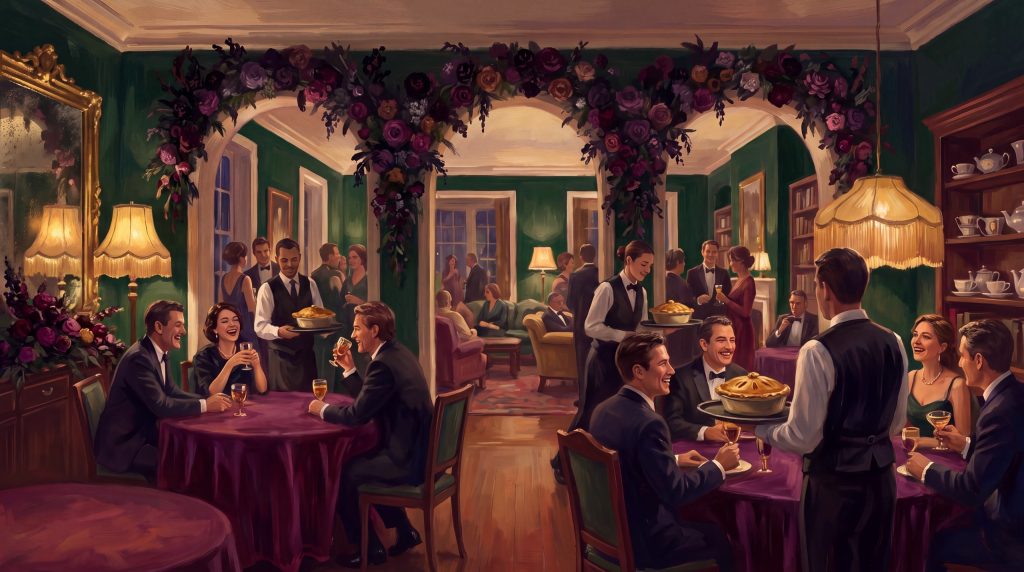
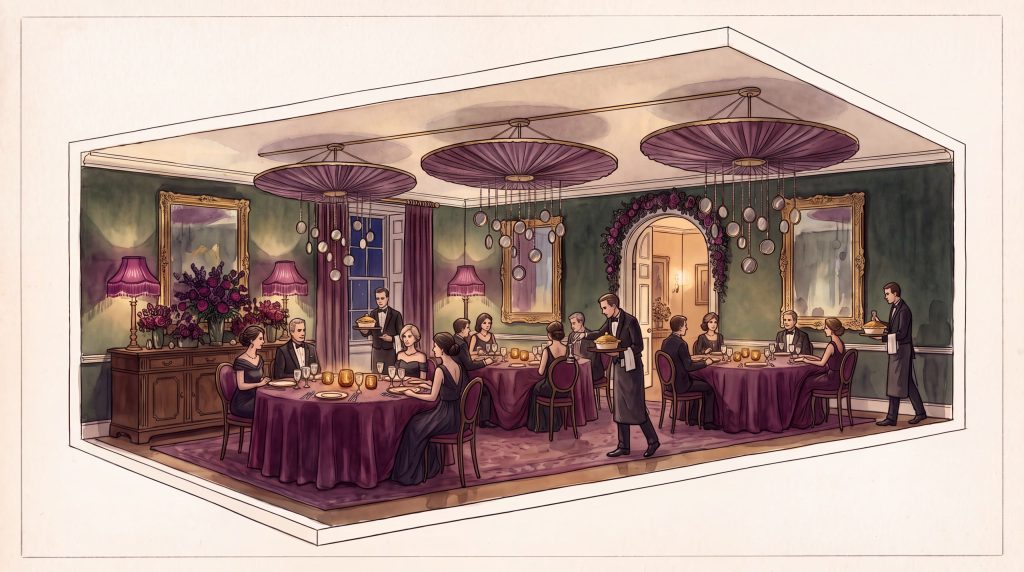
In the smallest version, eight people sit around one round table and discover nine complete settings. In the full World, the idea repeats across connected parlors: circular tables under plum textile architecture, foxed mirrors doubling low lamps, dark oak sideboards, handwritten cream cards and one untouched place inside every field of used glasses, moved chairs and dinner plates.
Nobody explains the chair.
Nobody pretends someone invisible is sitting in it.
Nobody gets hired to knock from inside a wall.
The room simply behaves as though invitations are allowed to be a little more ambitious than logistics.
The first lived scene

You arrive through a Coat Gallery that feels more like somebody’s beautifully overbuilt front hall than an event check-in. There is dark oak, warm lamp light, old mirror, cream paper and a brass claim disk that is satisfying in the hand in a way plastic coat-check tickets have never once managed to be.
From there, a long mirror passage pulls the room darker. Not horror-movie dark. Useful dark. The kind where the lamps matter, the velvet changes color when you move past it and a foxed mirror gives you two versions of the next room before you actually get there.
The first parlors are generous. There are places to sit. More importantly, there are places to put a drink, which remains one of those tiny hospitality details the world keeps trying to treat as optional.
Rye arrives cold in a heavy glass. The zero-proof version gets the same dignity. Sandwiches move around small lounge circles. Somebody finds the record stack. Somebody else notices a cream card with one corner turned down.
Then the doors into the Circle Rooms become the obvious next place to go.
The design idea
A séance is a circle before it is anything else.
That part is useful.
A round table has no head and no foot. It lets people see each other. It makes passing food feel natural. It also means the additional place cannot become the honored seat at the top of the table or the punishment seat at the bottom, because there is no top and no bottom.
That geometry is the backbone of the World.
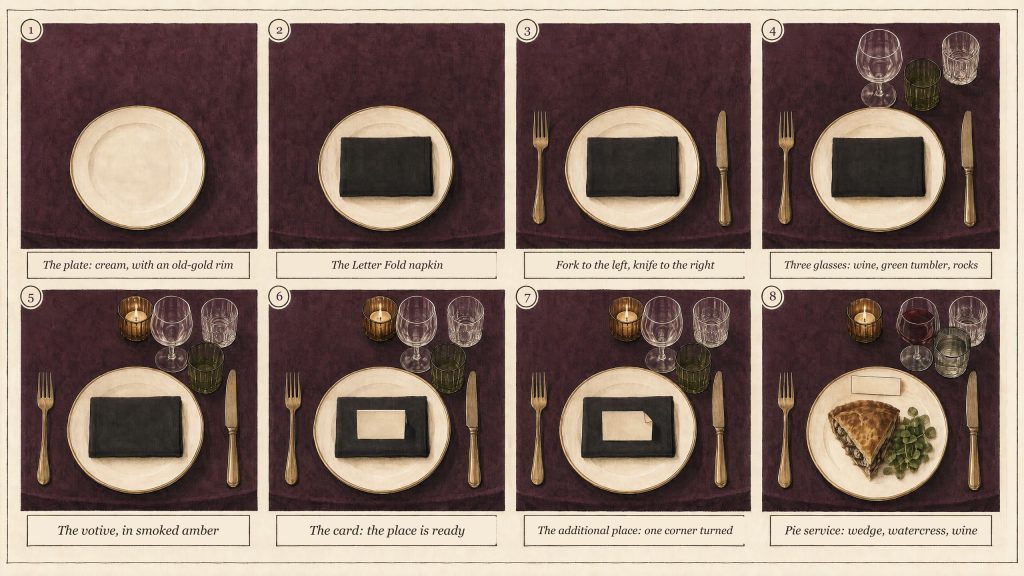
Each conversation circle gets eight living guests and one additional place in the signature expression. Every place is dressed to the same standard: cream plate with a thin old-gold rim, black napkin, brass flatware, bottle-green water tumbler, wine stem, heavy rocks glass and a low smoked-amber light.
The additional place does not get a rose.
It does not get a portrait.
It does not get a skull, a crystal, a ribbon, a lock of hair, a little sign explaining that this is where the mystery lives.
It gets exactly what everybody else gets.
And then it stays untouched.
The World at full scale
This is where the original parlor dinner becomes something much larger.
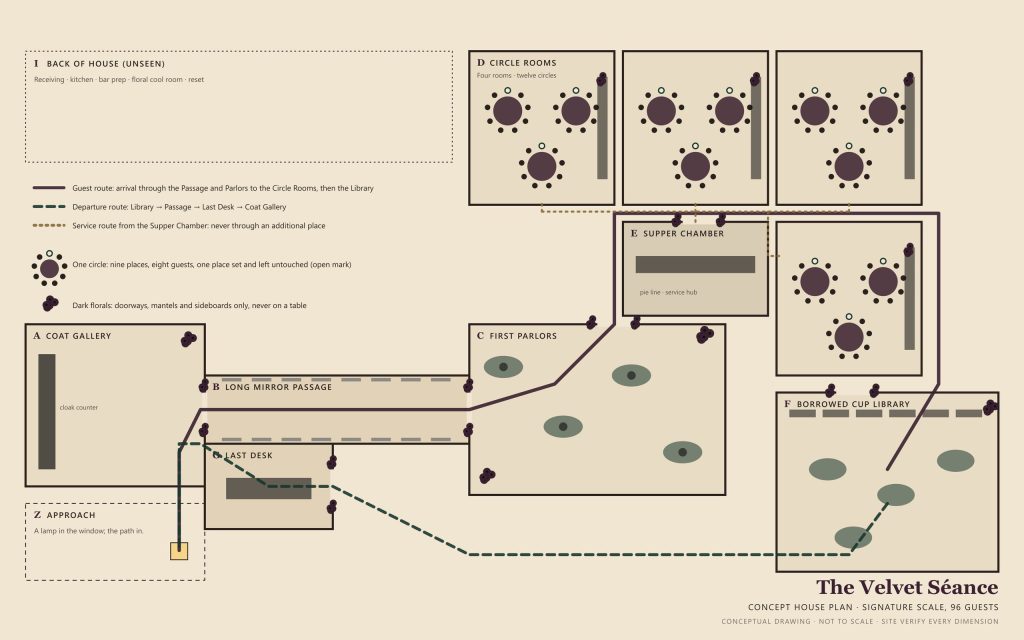
The complete Velvet Séance is built as an evening house rather than a banquet room: Coat Gallery, Mirror Passage, First Parlors, linked Circle Rooms, a visible supper-service chamber, a Borrowed Cup Library and a Last Desk.
At signature scale, roughly ninety-six living guests are distributed among twelve circles instead of being dumped into one room with a stage and a microphone. The experience gets larger by adding salons, not by sacrificing conversation.
That distinction is the whole point.
A grand event should change height, distance, service, repetition and discovery. It should not look like a small dinner that somebody dragged outward with the corner handle.
Above the circles, the ceiling is built from large pleated smoke-plum textile fields, narrow smoked-mirror elements and fine brass suspension, with dark flowers worked into the edges where one room meets the next.
The flowers live in the architecture: deep plum, wine and black-red blooms massed over the doorways, along the mantels and down the mirrored sideboards.
Foxed mirrors repeat points of lamp light. Velvet supplies the volume. The tables stay flower-free and open enough for people to see each other.
And the additional place never gets a flower. One bloom at an empty chair turns a dinner into a memorial, and this room is not one.
None of this is restraint. There is nothing particularly restrained about twelve velvet tables under an architectural ceiling with flowers climbing the doorframes.
The tables are simply where the people are.
What the room believes
The Velvet Séance believes that hospitality is more interesting when the host gives people something real to do.
Not an activity sheet.
Not a scavenger hunt somebody abandons beside the bar.
A social move.
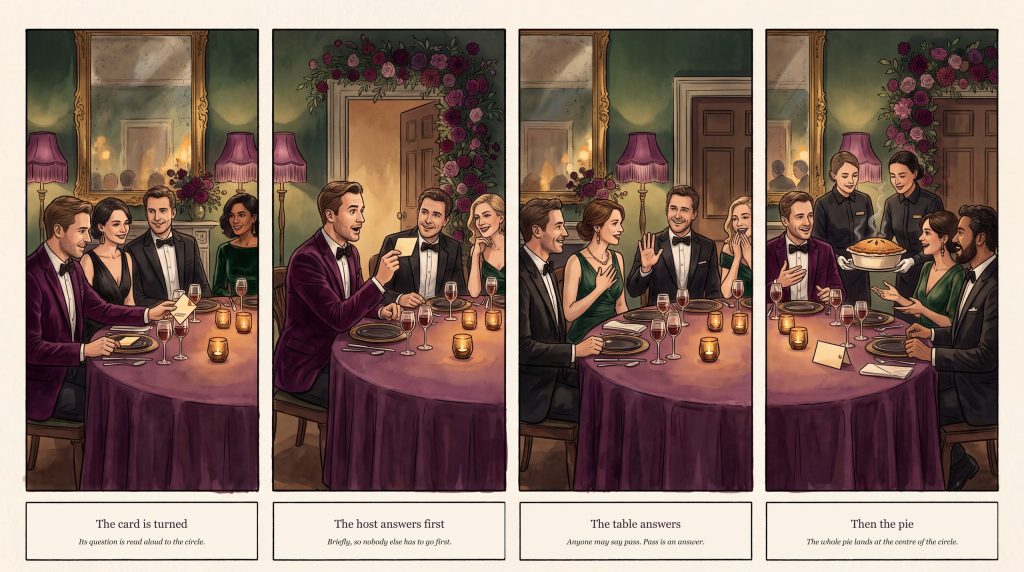
After the first passed food has gone around the circle and hopped the gap, the table captain turns the extra card.
The front says:
One additional guest.
The reverse asks:
Who would you have brought?
Pass is an answer.
The host answers first.
That is the “séance.”
Nobody contacts anyone. Nobody interprets anyone else’s answer. A guest can name a grandparent, a writer, a fictional detective, the friend who moved away, the person who should have been invited in the first place or absolutely no one at all.
Then the pie arrives.
The food
The recipes are written, not yet kitchen-tested.
The menu is built around things that travel well around a circle.
Sandwiches for the Empty Chair arrive first: cucumber, lemon, chive, proper butter, crusts off, the sort of sandwich that looks simple until you make a bad one and discover how quickly cucumber can destroy bread.
The main is Mushroom Pie, One Slice Unclaimed.
It arrives whole.
The table cuts one wedge per place.
One slice remains in the dish.
That matters more than any clever garnish ever could.
Watercress sits beside the pie because it tastes good there, not because the room needed “a botanical moment.”
Dessert is Chocolate in a Borrowed Teacup. The cups do not match. They are not supposed to. A room with this much interest in old paper and inherited objects would look ridiculous if dessert arrived in ninety-six identical white hotel cups.
The drinks
Rye, Rinsed and Unexplained is exactly as overthought as the title suggests.
The glass is heavy and properly cold. There is no ice in the finished drink. Lemon oil does the work and then leaves. The drink is amber, spare and a little strange without needing smoke trapped under a cloche.
The zero-proof drink uses jasmine, lemon and blackberry and gets the same cold glass, the same care and the same right to look like it belongs at the party.
Langhe Nebbiolo arrives with the pie.
At every circle, the additional wine glass stays dry.
Again: no announcement.
If the design is doing its job, the room does not need to explain every decision as it happens.
The culture of the World
The people who belong in this room like handwriting, old cups, records, dull brass, rooms with actual lamps and questions that are better than party games.
The recurring traditions are simple enough to become believable:
- One additional place.
- One turned card.
- One host who answers first.
- One slice held back.
- Borrowed cups after the formal table loosens.
- One optional line at the Last Desk before you leave.
The Last Desk prompt reads:
Next time, bring…
Guests can keep the card or put it in the drawer.
Nobody is required to share.
I like that part.
Not every good experience needs to become public evidence that the experience happened.
The design DNA
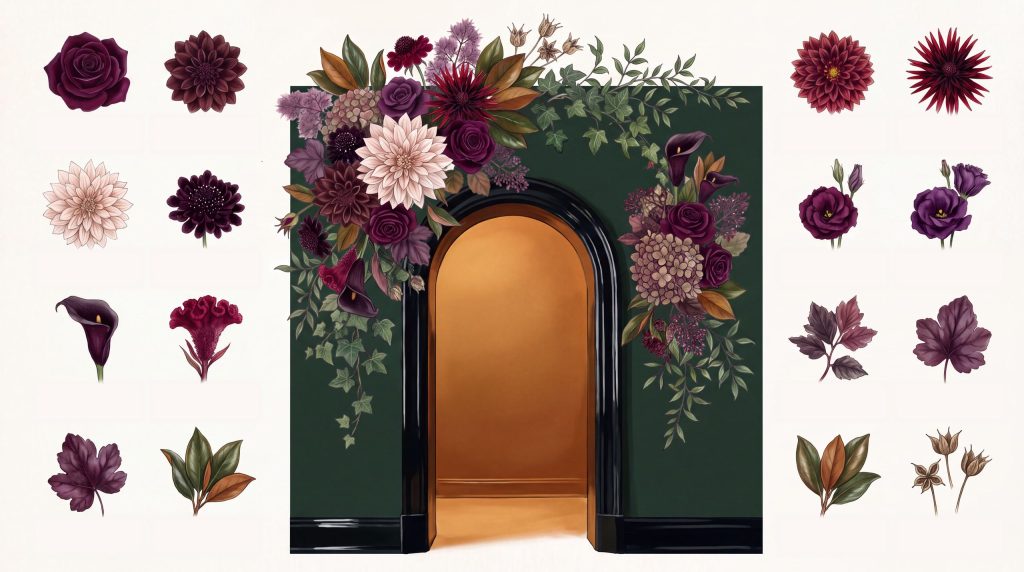
Color
- Plum velvet.
- Bottle green.
- Lacquer black.
- Laid cream.
- Sepia-black ink.
- Tarnished brass.
- Foxed silver.
- Smoked amber.
Materials
- Velvet with real pile.
- Dark oak.
- Worn black lacquer.
- Foxed mirror.
- Laid paper.
- Dull brass.
- Pressed green glass.
- Heavy clear glass.
- Cream glaze with a thin old-gold rim.
Light
Low, warm, practical-led. Fringed lamps matter. Tables stay readable. Darkness never gets to make a guest unsafe because the photographer wanted mood.
Floral language
In the rooms, never on the tables. Dark plum, wine and black-red flowers massed in doorways, on mantels and along sideboards. Nothing on the dining tables. Nothing at the additional place. No memorial bouquet. The room gets its abundance from flowers in the architecture, textile, reflection, object repetition, food and use.
Signature objects
- The additional card.
- The dry glass trio.
- The tucked chair.
- The fringed lamp.
- The pie dish.
- The borrowed cup.
- The brass claim disk.
- The record crate.
- The Last Desk drawer.
Appearance
Contemporary dark evening clothes in velvet, silk, crepe, wool and satin. Not costume. Not fortune teller. Not Victorian mourning. One good inherited-looking object beats six themed accessories.
The guest journey
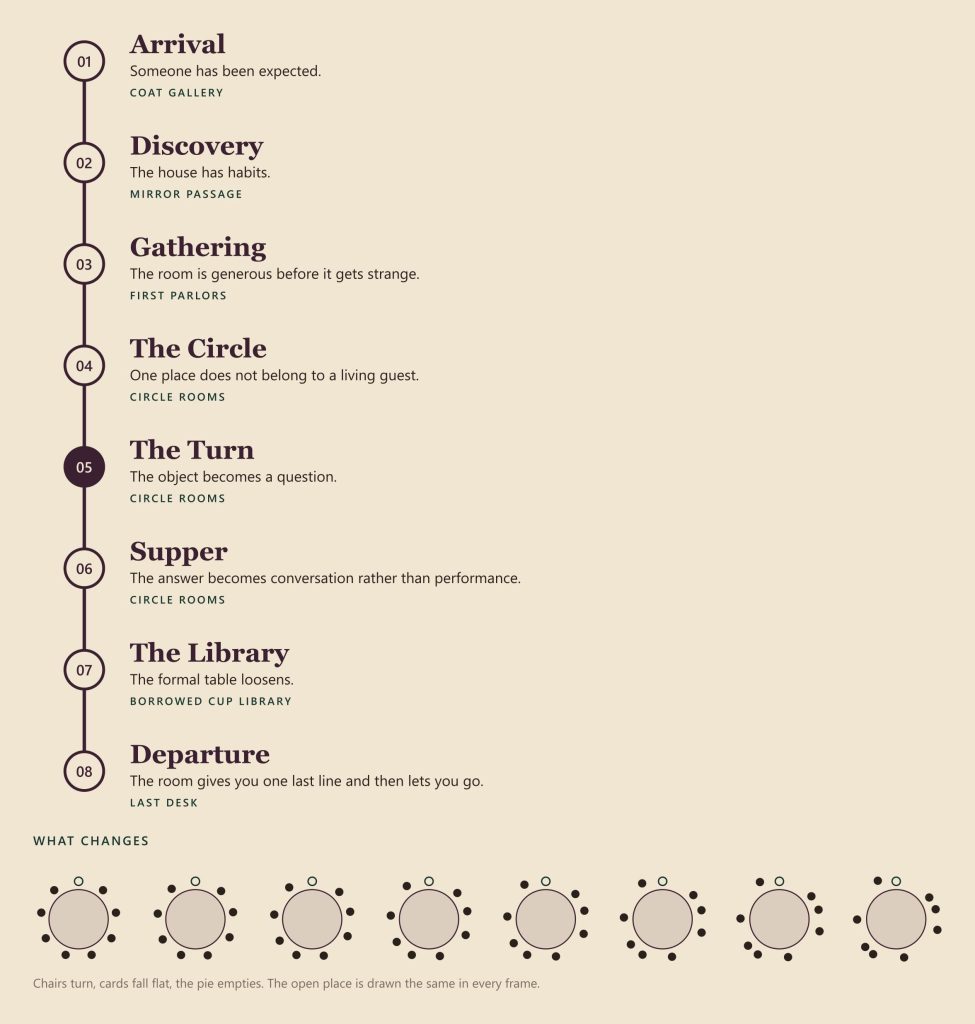
- Arrival — Someone has been expected.
- Discovery — The house has habits.
- Gathering — The room is generous before it gets strange.
- The Circle — One place does not belong to a living guest.
- The Turn — The object becomes a question.
- Supper — The answer becomes conversation rather than performance.
- The Library — The formal table loosens.
- Departure — The room gives you one last line and then lets you go.
What changes
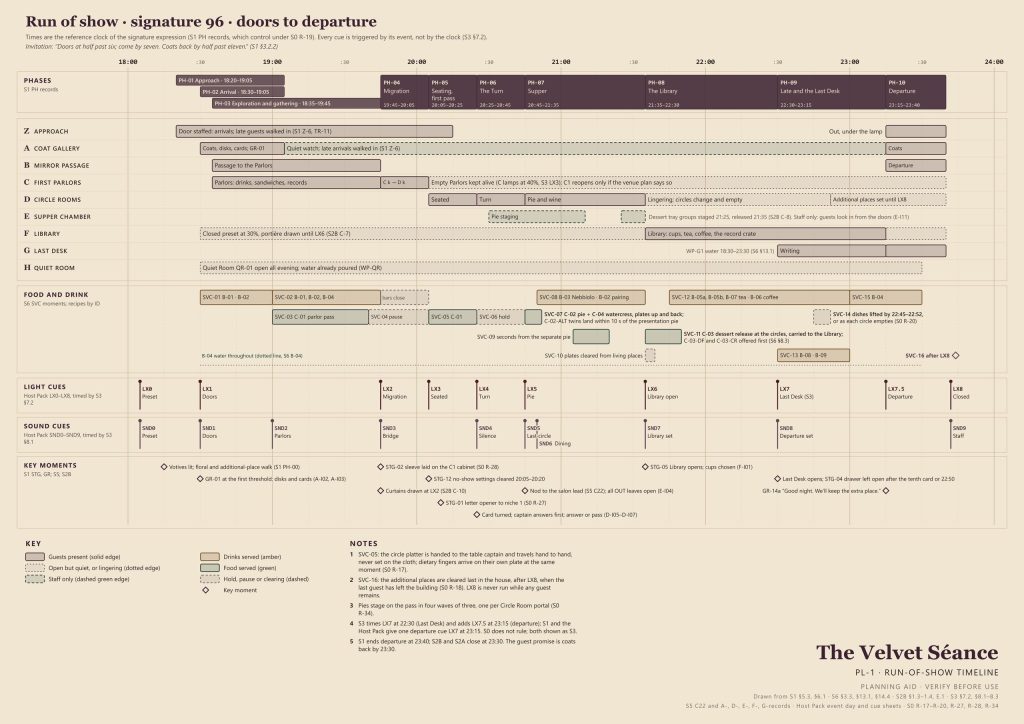
The room begins controlled.
It ends inhabited.
Cards move.
Chairs turn.
Napkins loosen.
Pie disappears.
Cups migrate.
Records move from one stack to another.
The Last Desk fills.
The additional places do not change.
That is what makes them visible by the end.
Who this World is for
- An October gala that wants atmosphere without haunted-house theater.
- A destination resort or venue building a seasonal signature event.
- A museum or historic property that wants social ritual without pretending to conduct spiritualism.
- A luxury private dinner scaled far beyond one dining room.
- A birthday near Halloween for someone who would sooner move house than wear a costume.
- A hospitality group that wants guests talking to each other rather than staring at a stage all night.
- A planner who understands that “dark and dramatic” is not a sufficient design brief.
The free Field Guide
The Included Field Guide is the best place to start if you want to understand how the World works before deciding whether you want to build it.
It includes the premise, culture snapshot, signature ritual, artifact preview, one environment, one course, one drink, one appearance direction, the guest-journey diagram and a look at how the intimate and grand expressions relate.
It does not include the full measured build logic, complete recipes, quantities, production schedules, cue sheets, vendor extracts, editable tools or professional adaptation records.
That is the job of the Complete World Package.
See how the World is built before you decide whether you want to build it.
Explore the Complete World Package
Own the design authority, Host Build + Run Pack, culinary systems, visual production records, diagrams and implementation tools.
Atmosphere OS · Theme Atelier
A palette is not yet a decision.
Atmosphere OS holds the color, the material, the light and the room in one object, so moving any of them shows you what it does to the rest. Costs come back as indicative bands and never as quotes, which is the difference between planning and pretending.
Costs come back as indicative bands rather than quotes, and seasonal notes are filters rather than promises.
If this is your mood
More dark & moody


Field notes and corrections
When a number here turns out to be wrong, you hear about it.
Three things arrive and nothing else. The new field note — bar rates, cover widths, service clearances, the arithmetic worked through on one real evening. A line when a new World or Mini Occasion opens, because a night only goes up once it can actually be thrown. And a correction whenever a rule in the published rulebook changes, or a number the tools rely on turns out to have been wrong. There is no weekly slot, because there is nothing weekly to put in it.
One email per field note or opening, plus corrections when a published figure moves. Unsubscribe from any of them.
Continue through the system
Pretty is still not a plan.
A party gets planned in roughly this order. Pick the chapter where your next problem lives.
What you have to decide next
One decision constrains the next. This is the order they actually happen in.
- Venue Will this room hold it? The Serpentine Table Is Eleven Percent Longer Than the Spec Sheet Says
- Guest experience How will guests move through it? The Place Setting Fits. The Person Does Not.
- Production How does it get built and run? The Event Needs a Failure Mode That Still Looks Intentional
- Vendors Who owns each handoff?
More in this chapter
See the complete five-chapter Event Design Intelligence map →
You must be logged in to post a comment.