Space & Venue Reality
A Jazz Club Is Dark, Close and Loud. That Is the Part Worth Copying.
A jazz club already understands darkness, music and attention. Borrow the room's actual behavior and skip the saxophone props, fake speakeasy signs and nostalgia merchandise.
A good jazz club already understands what evening is supposed to feel like: built-in darkness, live music, layered seating, a bar with a point of view and a room that knows how to hold attention.
The trap is just as obvious. Add brass instruments to the stationery, scatter records on the tables, write speakeasy on a sign, and the event has quietly become a costume.
A jazz-club event works when you borrow the room’s actual behavior, not its clichés.
Choose a venue that already knows how to hold attention
Look for layered seating, a clear performance focal point, flattering low light and enough acoustic control that music can be present without flattening conversation. Test the room with the lights where they will actually be during the event, and check where sightlines disappear before falling for the stage.
Design the arrival like it is the first song of the night
Do not march guests through a bright administrative corridor and expect the room to recover instantly. The threshold matters because the first thirty seconds set the tone for what follows. Make sure the bar, if it is the natural magnet, can absorb the opening rush without creating a wall of bodies at the entrance.
Use pools of light instead of one flat lighting level
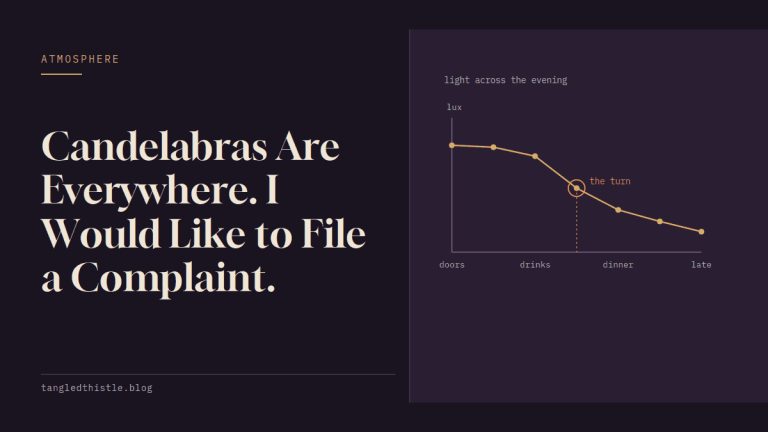
Brighter at the bar, warmer and lower at tables, safe at stairs and routes. A jazz-club mood does not mean guests should struggle to read a menu. Low light needs more planning, not less. A room this dark is the clearest case for treating light as the first design decision rather than the last rental line.
Let the furniture create social permission
Cabaret tables, banquettes, standing rails and lounge seating can be mixed deliberately. Not every guest wants to sit at one assigned table for the whole night, and the furniture can give them permission to move without feeling as though they have broken the program.
Make the performance part of the actual timeline
Live music changes pacing. Decide whether the band is background or the engine of the evening. Do not schedule speeches over a full backline reset, and do not place a featured dance, award or performance where half the room can see only a speaker cabinet.
Keep the visual language narrow, on purpose
Two or three material signals (walnut, smoked glass, aged brass) can do more than literal saxophone decor and faux prohibition signage. Objects that announce jazz are less convincing than a room that simply feels musical. That gap is the difference between a concept and a costume.
The bar is part of the set
Bars in nightlife spaces are often visually strong already. Use that asset instead of burying it under a rental installation because a moodboard said the event needs another focal point. Keep menus legible and present zero-proof drinks with the same care as everything else.
Know when the room actually needs silence
One of the most sophisticated moves in a music-led event is restraint. Pull the volume down for dinner or conversation. Let the later set feel like escalation rather than four unchanged hours at the same level.
What the room should feel like at the end of the night
If guests remember the room as intimate and musical, the design worked. If they remember novelty cocktail names and fake records glued to the seating chart, the concept became merchandise instead of atmosphere.
A music venue already has behavior, acoustics, lighting and social rules before the first rental arrives. Most of the design job is staying out of their way.
Space Lab
Unknown is a useful answer.
A room record can hold measured, published, supplied, estimated and unknown facts without pretending they are equivalent. The unknowns become the questions worth carrying to the site visit.
Free to use, with one reusable room record shared across the spatial instruments.
If this is your mood
More dark & moody


Field notes and corrections
When a number here turns out to be wrong, you hear about it.
Three things arrive and nothing else. The new field note — bar rates, cover widths, service clearances, the arithmetic worked through on one real evening. And a correction whenever a rule in the published rulebook changes, or a number the tools rely on turns out to have been wrong. There is no weekly slot, because there is nothing weekly to put in it.
One email per field note, plus corrections when a published figure moves. Unsubscribe from any of them.
Continue through the system
Pretty is still not a plan.
A party gets planned in roughly this order. Pick the chapter where your next problem lives.
What you have to decide next
One decision constrains the next. This is the order they actually happen in.
More in this chapter

See the complete five-chapter Event Design Intelligence map →